FSR Early Career Fellowship Grant
The FSR Early Career Fellowship Grant provides an opportunity for early-stage investigators to develop specialized skills, gain experience within the field of sarcoidosis, and contribute directly to advancing knowledge about sarcoidosis and enhancing medical care for sarcoidosis patients. Each candidate must apply with a proposed study that is innovative and likely to add significant knowledge to the field.
The FSR Early Career Fellowship Grant is designed to increase clinical and/or scientific engagement and commitment within the sarcoidosis field. The intent of the funding opportunity is to ensure medical and/or research-dedicated professionals interested in sarcoidosis can succeed in the field. FSR prefers that applicants are those hoping to utilize this funding opportunity to transition from Fellow to faculty appointment by enhancing their academic credentials, although candidates who are making a transition from other positions to increase research or to focus on sarcoidosis may also be eligible.
International applicants are welcome to participate in the FSR Fellowship Grant process. FSR limits applicants to submit only one grant proposal per funding cycle. Additionally, successful applicants are restricted from holding other FSR research funding at the time a new grant begins.
Fellowship Specifics:
- FSR will fund fellowships for a two-year period.
- Maximum funding for each fellowship is $75,000 per year ($150,000 over a two-year period).
- Applicants must be no longer than 6 years past their clinical or postdoctoral training. This does not include medical leave, FMLA, or pandemic-related delays.
- Applicants must describe career goals and specify how the Fellowship will be utilized in their training towards a long-term career commitment to sarcoidosis research and/or clinical care.
- Applicants must have an appropriate, dedicated, and significantly involved institutional mentor and/or mentorship team that is relevant to their project, and will support the applicant to enrich their knowledge of sarcoidosis. Co-mentors are allowed in situations where mentors with sarcoidosis-specific expertise are not available at the PI’s institution.
- Applicants must include plans for access and engagement with sarcoidosis patients as relevant to the proposed research project. Basic and translational science projects without direct engagement with patients should include clarification on access to sarcoidosis patients and/or patient samples.
- Applicants with NIH funding are not eligible for an FSR Early Career Fellowship. This includes R01, P01, P50, and other major individual career development awards (e.g., K01, K07, K08, K22, K23, K25, K76, K99/R00) or the equivalent.
-
- Current and former recipients of an NIH Small Grant (R03), Exploratory/Developmental Grants (R21/R33), Planning Grant (R34/U34), Dissertation Award (R36), or SBIR/STTR (R41, R42, R43, R44) remain eligible, as do awardees of Transition Scholar (K38) awards and individuals appointed to institutional K programs (K12, KL2).
- The award funding, restricted to the compensation package of the Fellow and associated research costs, will be provided directly to the hosting institution bi-annually, dependent on receipt of required progress reports.
- Funding cannot be applied to indirect costs. Mentor efforts are not covered.
- Fellow’s requested effort is 50-80% salary + fringe benefits
- The funding is to be applied as specified in the FSR-approved budget for the proposal.
- This grant in no way requires a grantee institution to provide employment beyond the grant period and in no way requires the Fellow to accept an employment offer provided by the grantee institution.
- Applicants must submit proof of IRB approval of their project, as applicable, before funding is released to the sponsoring institution. IRB approval must be obtained within 60 business days from award notice.
Applications will be evaluated in the following areas:
- Overall Impact of the Proposal
-
- Demonstration of significant impact from the project on the field of sarcoidosis
- Applicant
-
- Commitment to, or intent to pursue, a career related to sarcoidosis.
- Quality of academic background and previous training.
- Applicant’s description of career goals as related to long-term commitment to sarcoidosis research, quality care improvement, and education.
- Mentorship team
-
- Established sarcoidosis physician or laboratory-based scientist with experience in training fellows.
- Commitment of the primary Mentor for the duration of applicant’s training and/or project.
- Project Rationale, Purpose, and Feasibility
-
- Reason the study should be conducted
- Outlined scope of the project
- Likelihood study will be accomplished given approach
- Research Training Plan and Training Potential
-
- Overall quality and organization of the training program.
- Impact of proposed training on career development.
- Potential of training proposal to develop applicant into a productive, independent physician scientist or laboratory-based investigator.
- Environment
-
- Quality of institution’s sarcoidosis clinical and research programs.
- Institution’s commitment to provide opportunities for career development related to sarcoidosis.
Reports and Payments
- Bi-annual Report: The Fellow will collaborate with Mentor and send progress report of activities and associated financial reports during the award through Proposal Central (bi-annual reports).
- Grant fund payments will be contingent on and aligned with the bi-annual progress and financial report schedule.
- All Fellows and Mentors may be asked by FSR to participate in a patient-friendly colloquium reporting on the experience, research outcomes, and grant preparation and application process.
Any resulting publications or presentations must acknowledge the support of the host institution and FSR. FSR should be sent a copy of all resulting publications in PDF format.
Questions should be submitted to research@stopsarcoidosis.org
Any resulting publications or presentations must acknowledge the support of the host institution and FSR. FSR should be sent a copy of all resulting publications in PDF format.
If you have any questions, please contact research@stopsarcoidosis.org
2026 Timeline for Applicants
| Applications open | December 2025 |
| Deadline for applications | March 2, 2026 |
| Review period | March – May 2026 |
| Awardee notification | Late May 2026 |
Grant Writing Webinars
The Sarcoidosis Fellowship Grant Writing Webinar provided a comprehensive overview of strategies for crafting competitive grant applications focused on advancing sarcoidosis research. Experts shared insights on aligning research objectives with funding priorities, structuring proposals effectively, and addressing key evaluation criteria. The session emphasized the importance of collaboration, clear communication, and demonstrating potential impact. Attendees gained practical tools and resources to strengthen their applications and increase their chances of securing funding.
- This Grant Writing Webinar reviews exemplary tips, techniques, and examples from past fellowship awardees. Speakers include: FSR CEO, Mary McGowan, Dr. Paula Barreras, 2021-2023 FSR Fellowship funding recipient from Johns Hopkins University, and mentor of Dr. Barreras, Dr. Carlos Pardo-Villamizar of Johns Hopkins University.
- Speakers included: 2020-2022 FSR fellowship funding recipient: Dr. Shu-Yi Liao of National Jewish Health and FSR’s Scientific Advisory Board member and mentor of Dr. Liao – Dr. Lisa Maier of National Jewish Health, and FSR CEO Mary McGowan.
- This webinar in 2021 on how to write a successful proposal for FSR’s Fellowship Grant. This webinar highlight’s FSR’s 2021-2023 fellowship program, what a good grant application looks like, and tips and tricks from a fellowship awardee and their mentor. Speakers included: Dr. Elliott Crouser from Ohio State University and FSR’s Scientific Advisory Board Chair, Dr. Erica Herzog from Yale University and mentor to grant awardee, Dr. Changwon Ryu from Yale University and 2018-2020 FSR Fellowship Recipient.
Recent Fellowship Awardees
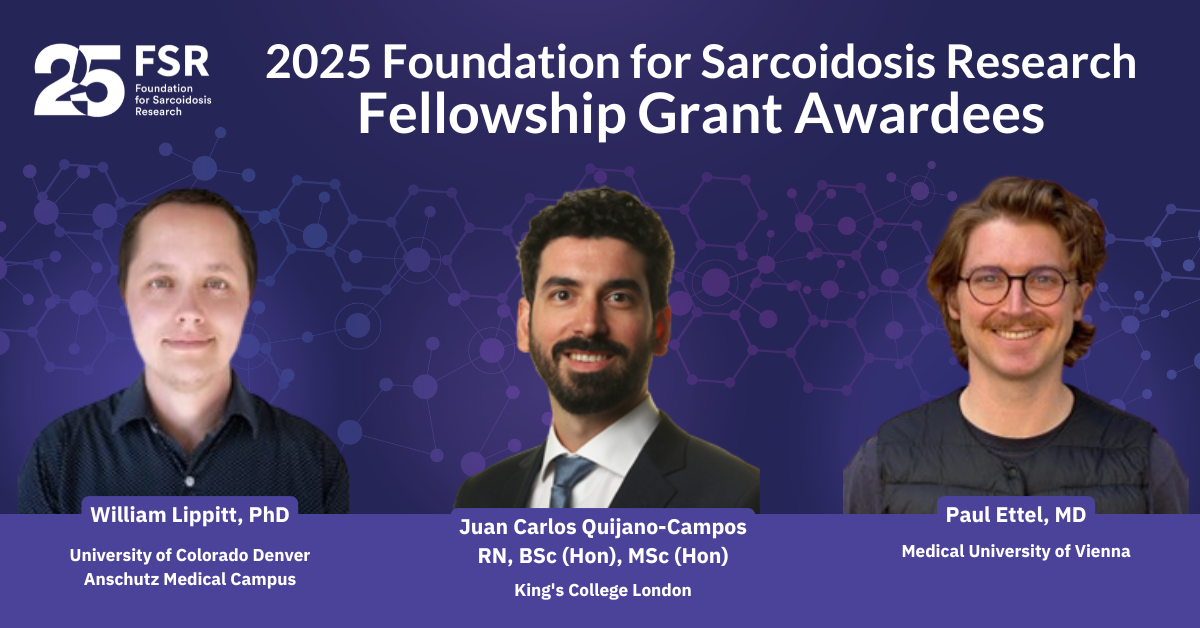
The Foundation for Sarcoidosis Research (FSR) is proud to announce the three recipients of the 2025 FSR Early Career Fellowship Grant: William Lippitt, PhD, (University of Colorado Anschutz Medical Campus), Juan Carlos Quijano-Campos, RN, BSc (Hon), MSc (Hon) (King’s College London), and Paul Ettel, MD, (Medical University of Vienna). Each awardee will receive $150,000 in funding to advance their sarcoidosis-focused research and contribute to improved patient outcomes.
2025 – 2027 Fellowship Program Awardee(s):
Wren Lippitt, PhD, University of Colorado Denver Anschutz Medical Campus
- Developing imaging biomarkers for sarcoidosis considering population health patterns
Juan Carlos Quijano-Campos, RN, BSc (Hon), MSc (Hon), King’s College London
- Health-related quality of life in cardiac sarcoidosis
Paul Ettel, MD, Medical University of Vienna
- Targeting metabolic crosstalk by immune cells in sarcoidosis
More Past Fellowship Grant Awardees
Fellowships
|
2025 |
Paul |
Ettel |
Medical University of Vienna |
Targeting metabolic crosstalk by immune cells in sarcoidosis |
|
2025 |
Wren
|
Lippitt |
University of Colorado Denver |
Developing imaging biomarkers for sarcoidosis while acknowledging health disparities |
|
2025 |
Juan Carlos |
Quijano-Campos |
King’s College |
Health-related quality of life in cardiac sarcoidosis: CARD-SARC validation |
|
2024 |
Miles |
Hagner |
University of Iowa |
role of airway epithelial responses (respiratory cells critical in immunological defense) in creating the immunological responses which lead to sarcoidosis |
|
2024 |
Greer |
Waldrop |
UCSF |
study RNA to help identify potential causes and strategies for generating therapies targeted to individuals in advancing the opportunity and effectiveness of treatment of neurosarcoidosis. |
|
2023 |
Christen |
Vagts |
UIC |
Immune mediators of active advanced pulmonary sarcoidosis |
|
2022 |
Nancy |
Lin |
National Jewish Health |
Defining MicroRNA Biomarkers in Sarcoidosis |
|
2021 |
Paula |
Barreras |
Johns Hopkins University |
Discovering pathogens in neurosarcoidosis: using next generation immunological and metagenomic methods for unbiased pathogen detection and antimicrobial antibody profiling. |
|
2020 |
Shu-Yi |
Liao |
National Jewish Health |
An omics precision medicine approach to explore the susceptibility and phenotypes of sarcoidosis |
|
2018 |
Ozioma |
Chioma |
Vanderbilt University Medical Center |
Microbiome and transcriptomic analysis of sarcoidosis pulmonary biopsies aiming to signify disease outcome. |
|
2018 |
Lori |
Garman |
Oklahoma Medical Research Foundation |
Studying how genetic and environmental factors affect immune cells that possibly predispose individuals to sarcoidosis. |
|
2018 |
Changwan |
Ryu |
Yale |
Understanding the racial disparities of sarcoidosis by elucidating the mechanistic relationship between innate immune mechanisms driven by DNA derived from mitochondria (mtDNA) and clinical phenotypes |
|
2018 |
Bryan |
Young |
Yale |
Novel patient-centered research in imaging and biomarkers of cardiac and thoracic sarcoidosis |